Manual
Each team keeps its own hardening scripts, and configuration drifts after the first update.

Cyberiad, a Haction product
Cyberiad’s AI agent hardens new and existing Linux servers to CIS, DISA STIG and ANSSI end to end, from tailoring the standard to signed releases your servers apply. It is accurate because it is deterministic: code computes every number and builds every change, and your team approves each release.
The problem
Hardening means configuring a server to a recognised security standard. Regulated organisations must show how their servers are configured, and the auditor asks: which rules, on which hosts, approved by whom?
Each team keeps its own hardening scripts, and configuration drifts after the first update.
When the auditor asks which rules were applied, on which hosts, and who approved the exceptions, the answer is a spreadsheet.
A new standard version or OS release means doing the work again, with no record of past decisions.
The scale of the task: the security guide for one distribution, RHEL 9, has 1,540 rules, and its DISA STIG profile alone selects 481 of them. Ubuntu, Debian, SUSE and others each have their own guides. (Source: the RHEL 9 security guide in the Cyberiad catalogue.)
Deterministic AI
The Cyberiad AI agent runs hardening from start to finish: it tailors the standard, prepares and tests each release, and explains the results. The language model chooses each step; code computes every number, resolves every rule and builds every change. Same input, same numbers and changes, every time.
Rerun any calculation and get the same numbers. Releases are immutable and versioned, so what was approved is exactly what is applied.
Every figure comes from a query over the security guides or from test evidence. If an AI draft quotes a number the evidence does not support, code rejects it.
Rules and values are computed exactly as the auditor’s scanner will evaluate them, before anything is applied.
Each change links to the standard, a Haction advisory, the reason and the approval.
The AI agent reads security-guide data and test evidence. Your servers pull signed releases themselves.
The agent works within your permissions. Every release needs four-eyes approval, which cannot be switched off.
How it works
The AI agent and your team work through one process, from a recognised standard to auditor-ready proof.
Pick the security guide for your distribution and the profile for your standard, for example CIS Level 1 Server for Ubuntu 24.04. Switch off rules that do not apply and set values such as password or session timeouts. Cyberiad validates every change and computes the result exactly as the auditor’s scanner will evaluate it.
A second person reviews and approves the tailoring (the four-eyes principle). Nobody can approve their own change, and every decision is recorded with its reason.
The approved version becomes an immutable, numbered release, signed with a cloud KMS key and with Sigstore keyless signing in a public transparency log.
Cyberiad delivers the release where you want it: an S3-compatible or Google Cloud Storage bucket, an OCI container registry, a GitHub or GitLab release, or a signed webhook.
Your server pulls the package, verifies checksums and signatures, and applies it with the included script, using tools from the distribution’s own packages wherever possible. Cyberiad never connects to the server.
Before-and-after scans show the effect. Every decision, approval, release and delivery sits in a tamper-evident audit trail.
The hardening loop
After each release, the AI agent checks it on a disposable test server, brings the findings back into Cyberiad and adapts the next release, until the full standard is in place.
A test runner you operate in your own cloud account builds a disposable server with the same operating system and applies the release: scan, harden, reboot, scan again, then health checks.
The agent investigates the results with read-only diagnostics. Code checks every number it reports against the evidence.
The agent proposes the next tailoring: exceptions where workloads need them, more rules where it is safe.
Your team reviews the proposal and approves the next release. Then the loop starts again.
A person reviews every analysis and approves every change. The usual choice for production estates.
Tests and analysis start automatically, for example for each new hardening release or new version of a standard. Findings and proposed changes wait in Cyberiad for your team’s approval.
Found in testing: on container hosts, the container engine switches IP forwarding back on at boot or when a container starts, undoing a CIS rule. The loop spots it and proposes a documented exception for those hosts instead of a setting that breaks containers.
New and existing systems
Apply the approved release when a server or image is built, so every new system starts hardened to the standard you chose and is checked by the same loop.
Start with a report-only run to see where each server stands. The AI agent then moves it towards the full standard release by release: safe rules first, documented exceptions where workloads need them, every step tested on a disposable server before it reaches production.
Expertise ready from day one
Results
Failing rules before and after applying a Cyberiad signed package to freshly installed servers: two remediation passes, then a fresh scan after a reboot.
| System | Standard | Failing before | Failing after | Rules evaluated |
|---|---|---|---|---|
| RHEL 9 | CIS Level 1 Server | 92 | 5 | 295 |
| Ubuntu 24.04 | CIS Level 1 Server | 105 | 7 | 408 |
| Debian 12 | ANSSI BP-028 intermediary | 84 | 10 | 225 |
On RHEL 9 the pass rate rose from 64.9% to 98.1% (share of rules that pass, of those that pass or fail; not-applicable rules excluded).
Measured on Haction’s own test machines (stock Google Cloud images), not on a customer estate. September 2026, reproduced on 7 October 2026 with signed release 1.0.2.
The remaining failures are rules that need a site decision (for example a bootloader password), a separate disk partition, or have no automated fix. That is normal, and Cyberiad lists them with advice.
Linux security guides in the catalogue
distinct rules across the catalogue
Haction advisories covering every rule, value and group
Catalogue and advisory figures as of 27–28 September 2026.
Inside Cyberiad
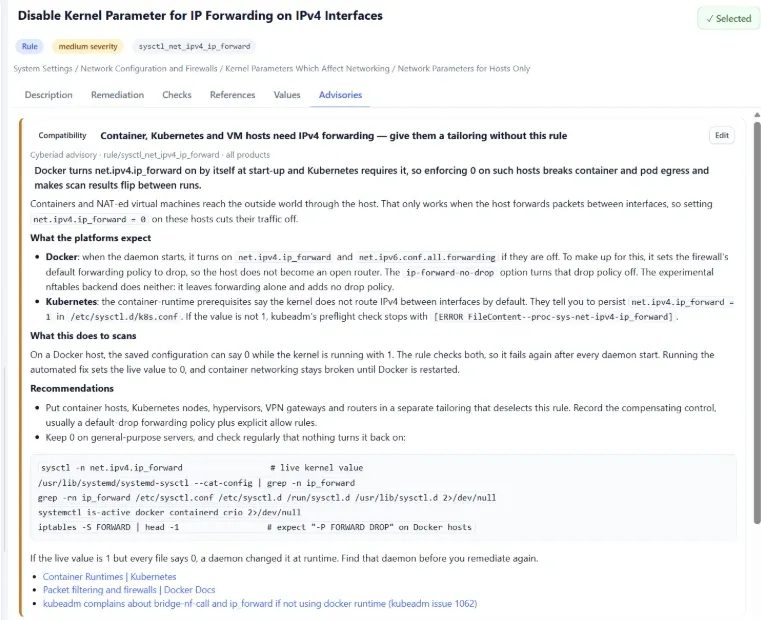
Cyberiad Advisories
Every rule, value and group in the catalogue carries curated guidance: why it matters (the threat, the MITRE ATT&CK technique, what fails without it) and how to implement it (what can break, rollout order, values to decide, one command to verify).
Written advisories are fact-checked: writers flag every statement they are unsure of, and checkers verify each against primary sources such as man pages, kernel documentation, distribution sources and NVD/MITRE, then correct, soften or remove what does not hold.
AI agent
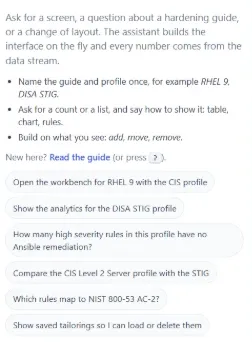
Ask “Which high-severity STIG rules have no Ansible fix?”, compare profiles or change the tailoring in plain language. The agent never calculates or remembers numbers: it runs deterministic queries over the parsed security guides and reports their results.
Security and architecture
Cyberiad holds no passwords or keys to your servers and never connects to them. Your servers pull and verify the package. Delivery to cloud buckets uses identity federation, with no stored keys.
A cloud KMS key (ECDSA P-256) and Sigstore keyless signing recorded in the public Rekor transparency log. Verify with cosign or openssl, without access to Cyberiad.
Append-only and hash-chained, so any later alteration is detectable. Exports to CSV and OCSF-shaped JSON Lines and streams to a SIEM through signed webhook batches.
Nobody approves their own revision, and releases are built only from approved revisions. Eight workspace roles, from owner to auditor and viewer.
Sign in with Microsoft Entra ID or any OpenID Connect provider. Open Policy Agent checks every screen action, AI agent action and API call; denials are recorded, and sensitive actions require a fresh sign-in.
Each organisation has its own workspace, with data isolation enforced in the database itself (row-level security), not only in the application.
Hosting and sovereignty
Cyberiad is a managed cloud service running in Google Cloud’s London region (UK). An instance in an EU region or an installation in your own infrastructure is available on request.
Coverage
Availability of each standard differs by distribution. You can also upload your own security content in standard formats. Standard names identify the standards Cyberiad implements; they do not imply certification or endorsement by the bodies that publish them.
Integrations
Cyberiad publishes standard, signed artefacts, so hardening slots into your existing delivery and configuration management.
Releases are published to GitHub or GitLab, an OCI registry or a cloud bucket, and a signed webhook can start your pipeline.
Generate an Ansible playbook from the approved tailoring, to review and run alongside your existing playbooks.
Your existing runs fetch the signed release, verify it and apply it with the included script.
Apply the release in Packer or any other image pipeline, so every new server starts hardened.
The audit trail streams to your SIEM through signed webhook batches and exports as CSV and OCSF-shaped JSON.
Sign in with Microsoft Entra ID or any OpenID Connect provider, with roles per workspace.
Cyberiad builds on the same open standards and the same open remediation content as the tools you already have.
| Category | Strong at | What Cyberiad adds |
|---|---|---|
| Compliance scanners | Assessing hosts against standards | Tailoring workflow, remediation delivery and signed releases |
| Vendor compliance services | Depth for one vendor’s OS | One process for mixed estates across distributions |
| Automation content | Applying changes at scale | Approval, signing and an evidence chain |
| GRC platforms | Collecting evidence and mapping controls | Changing and verifying host configuration |
| General-purpose AI assistants | Explaining and drafting | Deterministic numbers, approvals, signed releases and test evidence |
FAQ
Configuring a server to a recognised security standard, for example closing unneeded services, tightening SSH, and setting password and audit rules, so that it is harder to attack and easier to audit.
A standard is a published set of security recommendations, such as the CIS Benchmarks, DISA STIG or ANSSI BP-028. A security guide holds the machine-readable rules for one Linux distribution. A profile is the selection of rules and values in a guide that implements one standard, for example CIS Level 1 Server. A tailoring is your organisation’s changes to a profile, with the reasons.
In Cyberiad, the AI never decides the facts. The language model chooses which step to take and writes explanations; deterministic code computes every number, resolves every rule and builds every release. Given the same standard, tailoring and evidence, you get the same numbers and the same configuration every time, so an auditor can rerun the work and check it. The guarantee covers what an audit relies on: numbers, rule decisions and releases. The agent’s wording and proposals can vary, but nothing counts until code has computed it and people have approved it.
Yes: it tailors the standard, prepares and tests releases, analyses the results and proposes the next step. People keep the decisions that matter: every release needs four-eyes approval, and the agent can only do what the signed-in person is allowed to do.
CIS Benchmarks, DISA STIG and ANSSI BP-028 are the main ones; the guides also include PCI DSS, HIPAA, NIST 800-53 High/Moderate, NIST 800-171 (CUI), NERC CIP, BSI, CCN, Essential Eight, ISM and others. Availability depends on the distribution.
40 guides covering Red Hat Enterprise Linux 7–10, CentOS Stream, AlmaLinux, Oracle Linux, Ubuntu 18.04–24.04, Debian 10–13, SUSE Linux Enterprise 12, 15 and 16, SLE Micro, openSUSE, Fedora, Amazon Linux and more. You can also upload your own security content in standard formats.
Yes. Start with a report-only run to see where each server stands, then move towards the full standard release by release, with every step tested on a disposable server before it reaches production. New servers can apply the approved release when they are built.
No. Your servers pull the signed package from your own bucket, registry or repository, verify it and apply it. Cyberiad holds no passwords or keys to them.
No. The AI agent runs in Cyberiad, and your servers only apply signed releases, which use tools from your distribution’s own packages wherever possible. The optional test runner for the hardening loop runs in your own cloud account, not on your servers.
Every release is signed twice (a cloud KMS key and Sigstore keyless signing in a public transparency log) and ships checksums. You can verify it with cosign or openssl without Cyberiad.
Before-and-after scan reports, the approved tailoring with its reasons, the signed release that was applied, and an audit trail showing who approved and published what, and when.
The rules follow recognised public benchmarks and open-source security content, which is why auditors’ scanners understand them. You pay for everything around the rules: tailoring and approvals, signed and versioned releases, delivery to your environment, proof, the Haction advisories, and a maintained platform that keeps up with new standard and OS versions.
Some settings can affect applications. That is why every rule has an advisory that explains what can break and how to roll it out, and why the package can first run in report-only mode. Haction recommends a test environment before production rollout.
Yes: report-only evaluation, a generated shell script or Ansible playbook to review, and an HTML guide of the selected rules.
Testing and analysis can: for example for each new hardening release or new version of a standard, run by a test runner you operate in your own cloud account. Findings and proposed changes wait in Cyberiad for your team’s approval.
Yes. Cyberiad generates Ansible playbooks, and Puppet, Chef or SaltStack runs can fetch, verify and apply the signed release. Releases are published to GitHub or GitLab, an OCI registry or a cloud bucket, and a signed webhook can start your pipeline.
Today on Google Cloud in London (UK). An instance in an EU region or an installation in your own infrastructure is available on request.
Yes. Everything exports in open formats, and releases you received keep working and verifying without Cyberiad.
The audit trail streams to a SIEM through signed webhook batches and exports as CSV and OCSF-shaped JSON Lines. Native Splunk HEC and Microsoft Sentinel connectors are not available yet.
Microsoft Entra ID or any OpenID Connect identity provider, with roles per workspace. Sensitive actions require a fresh sign-in.
As an annual subscription per workspace, tiered by estate size, with unlimited users and all guides and advisories included. There is no per-host metering, so you can harden everything. Haction also offers pilots, tailoring workshops, exception management and audit preparation.
Book the free 30-minute demonstration on a Linux system and standard of your choice.
For advisory firms
Advisory and consulting firms can offer Cyberiad as a module of their compliance projects. Haction supplies the platform, the content and second-line support, with one workspace per client.
Next step
You pick the system and the standard; we show the whole process. Free, in our test environment, with no access to your network.
Email us